
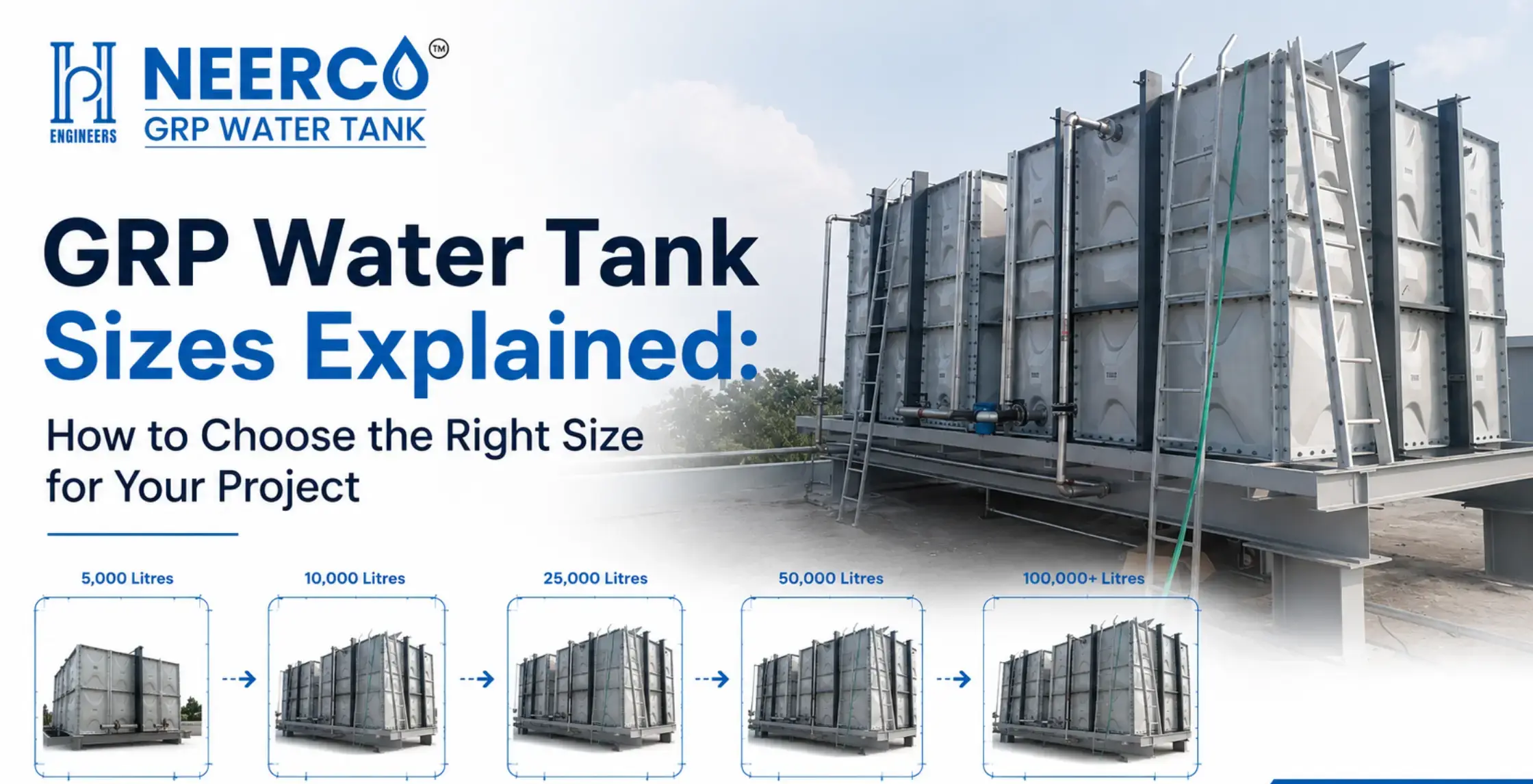
Choosing the right GRP water tank size is one of the most important decisions in any water storage project. Get it right and you enjoy reliable supply with no wasted cost; get it wrong and you face either constant shortages or an oversized, over-priced tank. This guide explains how GRP panel tank sizes work, gives a capacity reference, and walks through exactly how to calculate the right size for your project.
How GRP Panel Tank Sizes Work
Unlike fixed-mould plastic tanks with standard sizes only, GRP panel tanks are built from individual modular panels, typically in 1m × 1m and 0.5m × 1m dimensions. These panels are bolted together on-site, allowing independent adjustment of length, width, and height.
This modularity enables flexible capacity and footprint configurations. A 10,000-litre tank can be tall and narrow for rooftop installations or wide and low-profile for basements — maintaining identical capacity with different spatial arrangements.
Common GRP Water Tank Sizes and Capacity Reference
| Capacity | Approx. Dimensions (L × W × H) | Typical Application |
|---|---|---|
| 1,000 L (1 KL) | 1m × 1m × 1m | Small residential, individual homes |
| 2,000 L (2 KL) | 2m × 1m × 1m | Small homes, shops |
| 5,000 L (5 KL) | 2m × 1m × 2.5m | Mid-size homes, small offices |
| 10,000 L (10 KL) | 2m × 2m × 2.5m | Residential buildings, hostels |
| 25,000 L (25 KL) | 5m × 2m × 2.5m | Commercial complexes, schools |
| 50,000 L (50 KL) | 5m × 4m × 2.5m | Hospitals, hotels, factories |
| 1,00,000 L (100 KL) | 5m × 4m × 5m | Large industrial, fire-fighting reserves |
| 5,00,000 L + | Custom configuration | Municipal, large-scale infrastructure |
How to Choose the Right GRP Water Tank Size
1. Daily Water Consumption
Understanding daily water consumption at the site is the starting point for tank selection.
Standard consumption benchmarks used in India:
- Residential (per person per day): 135 to 200 litres
- Office/Commercial (per person per day): 45 to 90 litres
- Hospital (per bed per day): 340 to 450 litres
- Hotel (per room per day): 180 to 350 litres
- Industrial/Factory: Varies significantly based on process requirements
Multiply daily per-person consumption by the number of users or units to establish base daily demand.
2. Storage Duration: How Many Days of Backup Do You Need?
After determining daily demand, decide the required reserve storage duration.
For most residential and commercial projects in India, the standard is 1 to 2 days of backup storage to account for municipal supply disruptions, tanker delays, or pump failures.
For hospitals, hotels, fire-fighting systems, and industrial plants, a minimum of 2 to 3 days is recommended and sometimes mandated by building codes.
Simple formula:
Tank Capacity = Daily Demand (litres) × Number of Storage Days
For example: A housing society with 100 residents, 150 litres per person daily, needing 2 days of backup:
100 × 150 × 2 = 30,000 litres
3. Available Space and Installation Type
GRP water tank sizes depend on physical space available for installation.
Rooftop installations have load-bearing constraints; tank dimensions must fit the terrace area and the slab must handle filled weight. Rooftop tanks often use compact configurations with higher height-to-footprint ratios.
Ground-level or underground installations face fewer footprint restrictions, making wider, lower-profile configurations generally easier to maintain.
4. Future Expansion
A practical GRP advantage is expandability through additional panels if water demand increases.
However, planning the correct size initially is generally preferable. Expansion requires additional civil work and operational downtime. For projects expecting scaling, add 15 to 20 percent buffer to calculated capacity during initial installation.
GRP Panel Tank Size Selection by Project Type
Residential Buildings
For a standard 10-floor residential building with 4 flats per floor (40 flats) and average 4 residents per flat:
- Total residents: 160
- Daily consumption: 150 litres per person
- Daily demand: 24,000 litres
- 2-day backup: 48,000 litres
Recommended tank size: 50,000 litres (50 KL)
Schools and Educational Institutions
For a school with 800 students and 50 staff:
- Daily consumption: 45 litres per person (NBC norms)
- Daily demand: 38,250 litres
- 1-day backup: 38,250 litres
Recommended tank size: 40,000 to 50,000 litres
Hospitals
For a 50-bed hospital:
- Consumption: 400 litres per bed per day
- Daily demand: 20,000 litres
- 3-day backup (healthcare standard): 60,000 litres
Recommended tank size: 60,000 to 75,000 litres
Industrial and Factory Use
Industrial water demand varies significantly by process type. A general production facility with 200 workers and moderate process needs may require 50,000 to 2,00,000 litres depending on manufacturing processes. For industrial projects, site-specific assessment is always recommended.
Common Mistakes to Avoid When Selecting GRP Water Tank Size
- Underestimating peak demand: Daily average and peak-hour demand differ. Morning and evening surges require adequate tank capacity to prevent supply interruption.
- Ignoring fire-fighting reserve: Commercial buildings, high-rise residences, and industrial facilities require separate fire-fighting reserves under NBC norms. This capacity must be added separately, not included in domestic storage calculations.
- Choosing size based on price only: Smaller tanks cost less initially but result in frequent tanker deliveries, increased pump cycles, and supply disruptions — adding operational costs over time.
- Not accounting for installation location: A tank fitting on paper may not fit available rooftop or basement space. Always finalise dimensions against actual site plans before ordering.
When to Get a Custom Size
Standard GRP sizes cover most residential, commercial, and industrial requirements. Projects with unusual footprints — long narrow basements, irregular terrace shapes, or heritage buildings with restricted access — benefit from custom configurations.
Because GRP tanks are modular, customizing length-width-height ratios for non-standard spaces doesn't significantly increase lead time or cost compared to concrete solutions with equivalent specifications.
For complex projects, sharing site drawings and capacity calculations with manufacturers enables site-specific recommendations.
Conclusion
Selecting the correct GRP water tank size from the start saves time, money, and operational problems throughout the project lifecycle. The calculation is straightforward — daily demand, backup days, site constraints, and future growth — but each factor requires correct application for accuracy.
GRP modular tanks are flexible enough for requirements from 1,000-litre home installations to multi-lakh litre industrial systems. Understanding actual project needs before selecting a configuration is essential.